






Published: September 21, 2026|Author: Pradeep Mehra
What Is a B2B2C Business Model In 2026: Meaning, Examples, And Strategies of Business to Business to Consumer
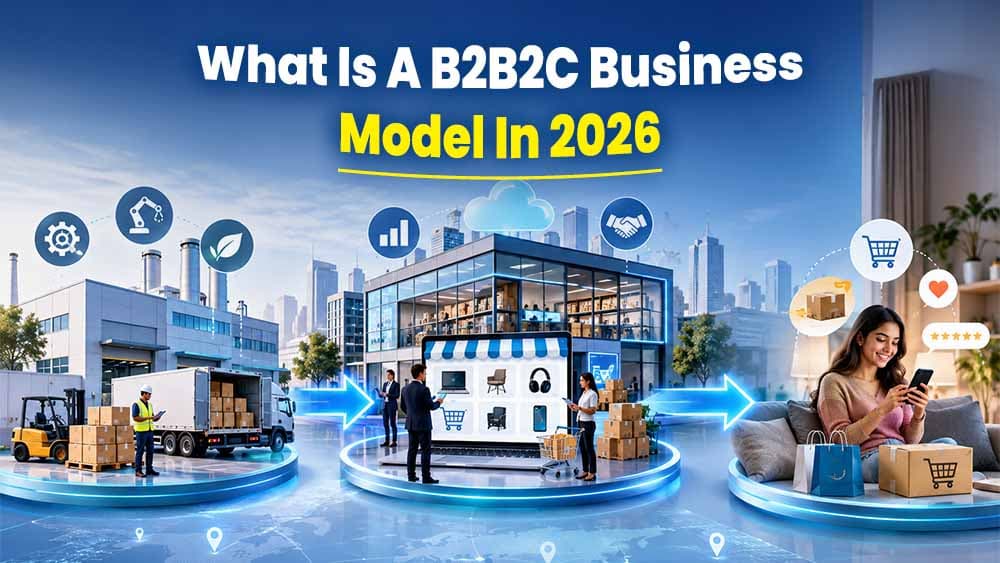
Businesses today are no longer restricted to selling directly to other businesses or consumers. With digital marketplaces, e-commerce platforms, aggregators, fintech platforms, and partner ecosystems becoming increasingly connected, companies can collaborate to reach customers more efficiently. This has led to the growth of the B2B2C business model, or Business-to-Business-to-Consumer model.
A B2B2C model connects two businesses to serve the end consumer. One business provides the product, service, or underlying capability, while another business provides the platform, distribution network, technology, or customer access needed to reach consumers. Both businesses can remain visible to the customer and share responsibilities across sales, fulfilment, payments, service, or customer engagement. Cognilix helps businesses build a B2B platform to ease their business processes.
In 2026, B2B2C is particularly relevant for ecommerce, marketplaces, financial services, food delivery, travel, digital services, SaaS and other platform-led businesses. This guide explains what B2B2C means, how the B2B2C business model works, its benefits and challenges, real-world examples, and strategies businesses can use to implement it effectively.
What Is the B2B2C Business Model?
B2B2C stands for Business-to-Business-to-Consumer. It is a business model in which two businesses work together to deliver a product or service to an end consumer.
In a typical B2B2C model:
Business A → Business B → Consumer
Business A may manufacture a product or provide a service, while Business B provides the platform, marketplace, technology, distribution network, or customer access through which the consumer discovers and purchases the offering.
For example, a grocery retailer can partner with an online delivery platform. The retailer provides the products, while the platform provides digital discovery, ordering, payment, and delivery capabilities. The consumer gets the product through a combined ecosystem involving both businesses.
Unlike a conventional wholesale arrangement, B2B2C can allow both businesses to maintain visibility in the customer journey and participate in the overall consumer experience.
B2B2C Meaning in Simple Words
The simplest way to understand B2B2C meaning is that one business partners with another business to reach and serve the final consumer. The second business acts as an important bridge between the first business and its target customers.
For example:
Manufacturer → Ecommerce Marketplace → Consumer
The manufacturer supplies the product, the marketplace provides the digital storefront and customer reach, and the consumer purchases the product through the marketplace. This approach enables companies to expand their customer reach without necessarily building every part of the consumer-facing infrastructure themselves.
How Does the B2B2C Model Work?
A B2B2C business model generally involves three participants:
1. Product or Service Provider
The first business creates or supplies the product or service. It may be a manufacturer, retailer, financial institution, software company, restaurant, healthcare provider or service provider.
Its responsibilities may include:
- Product or service development
- Pricing and product information
- Inventory or service availability
- Product quality
- Brand management
- Order fulfilment, depending on the agreement
2. Partner or Intermediary Business
The second business provides access to consumers through a platform, marketplace, distribution network, technology solution or service ecosystem.
It may manage:
- Digital storefront
- Customer acquisition
- Search and discovery
- Payments
- Logistics
- Customer support
- Technology infrastructure
- Data and analytics
The exact responsibilities depend on the commercial agreement between the two businesses.
3. End Consumer
The consumer is the final user or buyer of the product or service.
The customer may interact with both brands during the buying journey. For example, a consumer may discover a restaurant through a food-delivery platform but still recognise the restaurant as the provider of the food.
Understand the B2B2C Business Model with an Example
Consider a simple ecommerce example. A manufacturer produces home appliances but does not have a large consumer-facing ecommerce operation.
It partners with an ecommerce marketplace.
Manufacturer → Ecommerce Marketplace → Consumer
The manufacturer provides the products and product information. The marketplace provides online discovery, ordering, payments, and potentially logistics. The consumer searches for the product, places the order, and receives it through the combined ecosystem.
This arrangement can help the manufacturer access a broader customer base while allowing the marketplace to expand its product selection.
Popular B2B2C Examples
The B2B2C model can be found across multiple industries. Some commonly cited examples include e-commerce marketplaces, grocery delivery, restaurant platforms, and reservation services.
1. Instacart
Instacart connects consumers with grocery retailers through its digital platform. Retailers can make their products available to consumers through the platform, while Instacart provides the digital ordering and delivery infrastructure. This demonstrates how a platform can help an established business reach consumers through an additional digital channel.
2. OpenTable
OpenTable provides restaurants with a platform for customer discovery and reservations. Restaurants benefit from access to consumers searching for dining options, while consumers can discover restaurants and make reservations through the platform.
3. Food Delivery Platforms
Food delivery platforms provide another common B2B2C use case.
Restaurant → Delivery Platform → Consumer
The restaurant prepares the food, while the platform can provide customer discovery, ordering, payment, and delivery services.
4. Ecommerce Marketplaces
An ecommerce marketplace can connect manufacturers, brands, or sellers with consumers. The seller provides the product, while the marketplace provides the digital infrastructure required for product discovery, transactions, and customer engagement.
5. Travel Booking Platforms
Hotels, airlines, and other travel providers can work with booking platforms to reach consumers searching for accommodation or travel services. The platform brings together consumer demand and multiple service providers in one digital environment.
6. Digital and SaaS Platforms
Software platforms can also operate through B2B2C structures when a business provides technology that enables another business to deliver services to consumers. For instance, a technology provider may supply the infrastructure while a partner business uses it to deliver a consumer-facing service.
B2B vs B2C vs B2B2C
Understanding the difference between these models is important when developing a business or e-commerce strategy.
Business Model | Primary Relationship | End Customer | Typical Approach |
B2B | Business → Business | Business | Products/services sold to organisations |
B2C | Business → Consumer | Consumer | Business sells directly to individuals |
D2C | Brand → Consumer | Consumer | Brand sells directly without traditional intermediaries |
B2B2C | Business → Business → Consumer | Consumer | Two businesses collaborate to reach and serve consumers |
The key difference is the role of the partner business. In B2B2C, the partner is not simply an internal supplier or conventional reseller; it can provide the technology, platform, distribution or customer access that connects the product or service provider with the end consumer.
Key Benefits of the B2B2C Business Model
1. Wider Customer Reach: One of the biggest advantages of B2B2C is access to an established customer base. A business can leverage its partner's audience rather than building every customer acquisition channel independently.
2. Faster Market Expansion: Partnering with an established marketplace, retailer, aggregator or digital platform can make it easier to enter new customer segments and geographic markets.
3. Lower Infrastructure Investment: Businesses can leverage existing technology, logistics, payment infrastructure or distribution capabilities instead of developing everything internally.
4. Better Customer Convenience: Consumers can discover multiple products or services through platforms they already use. A broader product selection and integrated purchasing journey can improve convenience.
5. Shared Capabilities: Businesses can combine their strengths. One company may have manufacturing expertise, while another has technology, distribution, marketing, or customer acquisition capabilities.
6. New Revenue Opportunities: Depending on the commercial arrangement, revenue can come through commissions, transaction fees, subscriptions, service fees, sales margins, lead-generation fees, or other agreed commercial structures.
B2B2C Strategies for Businesses in 2026
Businesses planning to adopt a B2B2C strategy should focus on the entire customer journey rather than simply adding another sales channel.
1. Choose the Right Business Partner
The right partner should have relevant customers, strong technology capabilities, geographic reach, operational capacity, and a business model that complements your offering.
Evaluate:
- Customer base
- Market reach
- Technology capabilities
- Fulfilment network
- Brand alignment
- Pricing structure
- Data-sharing policies
- Customer support capabilities
2. Define Roles and Responsibilities
Before launching, clearly define who owns each part of the customer journey.
For example:
Business Function | Business A | Business B |
Product development | ✓ | |
Product listing | ✓ | ✓ |
Customer acquisition | ✓ | |
Payment processing | ✓ | |
Inventory | ✓ | ✓ |
Delivery | As agreed | As agreed |
Customer support | As agreed | As agreed |
Returns/refunds | As agreed | As agreed |
Clearly documented responsibilities can reduce operational conflicts as transaction volumes grow.
3. Build Integrated Product and Inventory Data
Accurate product information is essential for B2B2C ecommerce.
Businesses should maintain synchronised information for:
- Product descriptions
- SKUs
- Pricing
- Availability
- Images
- Specifications
- Inventory
- Order status
- Delivery information
Modern B2B2C commerce often depends on integrations that keep product, inventory, and order information consistent across participants.
4. Create a Seamless Customer Journey
Consumers should not feel that they are moving between disconnected businesses.
The buying journey should be simple:
Discover → Compare → Select → Purchase → Pay → Receive → Support
Consistent product information, transparent pricing, accurate availability, and reliable delivery can improve the overall experience.
5. Use Customer and Transaction Data Responsibly
B2B2C partnerships can generate valuable insights into customer preferences, purchasing behaviour and product demand.
Businesses can use these insights to improve:
- Product assortment
- Personalisation
- Pricing
- Promotions
- Inventory planning
- Customer retention
- Cross-selling
However, data access and usage should be defined clearly between partners and handled in accordance with applicable privacy requirements.
6. Automate Procurement and Order Management
For businesses operating at scale, manual procurement and order processing can become difficult to manage.
Digital procurement systems can help businesses streamline activities such as:
- Purchase requisitions
- Purchase orders
- Supplier management
- RFQs
- Approvals
- Inventory visibility
- Order tracking
- Invoice processing
This becomes particularly important when a B2B2C ecosystem involves multiple suppliers, distributors, warehouses and fulfilment partners.
7. Monitor the Right KPIs
Businesses should measure both partner performance and consumer outcomes.
Important B2B2C KPIs include:
- Customer acquisition cost
- Conversion rate
- Average order value
- Repeat purchase rate
- Order fulfilment rate
- Delivery time
- Return rate
- Customer satisfaction
- Partner-generated revenue
- Gross margin
- Customer lifetime value
Tracking these metrics can help identify operational bottlenecks and opportunities for optimisation.
How Procurement Technology Supports B2B2C Businesses
As B2B2C businesses grow, managing suppliers, inventory, purchase orders and fulfilment across multiple partners can become increasingly complex.
A digital procurement platform can help businesses centralise procurement workflows and improve visibility across purchasing activities. Businesses can use procurement technology for supplier discovery, RFQs, purchase orders, approvals, spend analysis, inventory planning and other procurement processes.
For organisations managing multiple suppliers and product categories, integrated procurement can help connect sourcing, purchasing, inventory and fulfilment more efficiently.
This is particularly relevant for ecommerce marketplaces, manufacturers, distributors and businesses operating multi-channel sales ecosystems.
Conclusion
The B2B2C business model combines the strengths of B2B partnerships with the customer reach and experience of B2C commerce. Instead of building every part of the customer journey internally, businesses can collaborate with marketplaces, retailers, technology providers, aggregators and other partners to reach consumers more efficiently. In 2026, the model is particularly relevant for digital commerce and platform-based businesses where customer access, technology, fulfilment, data and procurement need to work together. A successful B2B2C strategy therefore requires more than finding a distribution partner. Businesses need clear commercial agreements, integrated systems, reliable product and inventory data, defined customer ownership and measurable performance metrics.
For companies looking to scale their ecommerce, supplier network, or procurement operations, combining B2B2C commerce with digital procurement and supply-chain technology can simply connect with India's best ecommerce platform providers, Cognilix. We help develop a powerful, sustainable, and AI-powered B2B2C platform, connecting suppliers, manufacturers, and end customers.
Frequently Asked Questions
What does B2B2C stand for?
B2B2C stands for Business-to-Business-to-Consumer. It describes a business model where two businesses collaborate to deliver a product or service to an end consumer.
What is an example of B2B2C?
Examples include grocery retailers using digital delivery platforms, restaurants using food-delivery platforms, and businesses selling products through e-commerce marketplaces.
What is the difference between B2B and B2B2C?
B2B involves a business selling to another business, while B2B2C involves two businesses collaborating to reach the final consumer.
Is B2B2C the same as B2C?
No. B2C involves a direct business-to-consumer relationship, while B2B2C includes another business that provides customer access, technology, distribution or another important part of the commercial journey.
What are the advantages of B2B2C?
Key advantages include wider customer reach, faster market expansion, access to existing infrastructure, shared capabilities, and potentially lower investment in customer acquisition or technology.
Is B2B2C useful for ecommerce?
Yes. B2B2C ecommerce can help manufacturers, retailers, brands, and service providers reach consumers through marketplaces, platforms, and other digital partners while retaining participation in the customer journey.

Pradeep Mehra
About the Author: Pradeep Mehra is a passionate content strategist and B2B technology writer with a deep understanding of industrial procurement, e-commerce, and digital transformation. With years of experience in crafting research-backed articles, marketing copies, and brand stories, he specializes in making complex topics like AI in procurement, supply chain automation, fintech, and industrial product innovation easy to understand and engaging to read. Beyond his writing, Pradeep is driven by a passion for discovering market insights and building digital communication strategies that strengthen brand connections.