






Published: September 14, 2026|Author: Pradeep Mehra
What Is Source-to-Contract (S2C)? Comprehensive Meaning, Process, and Steps
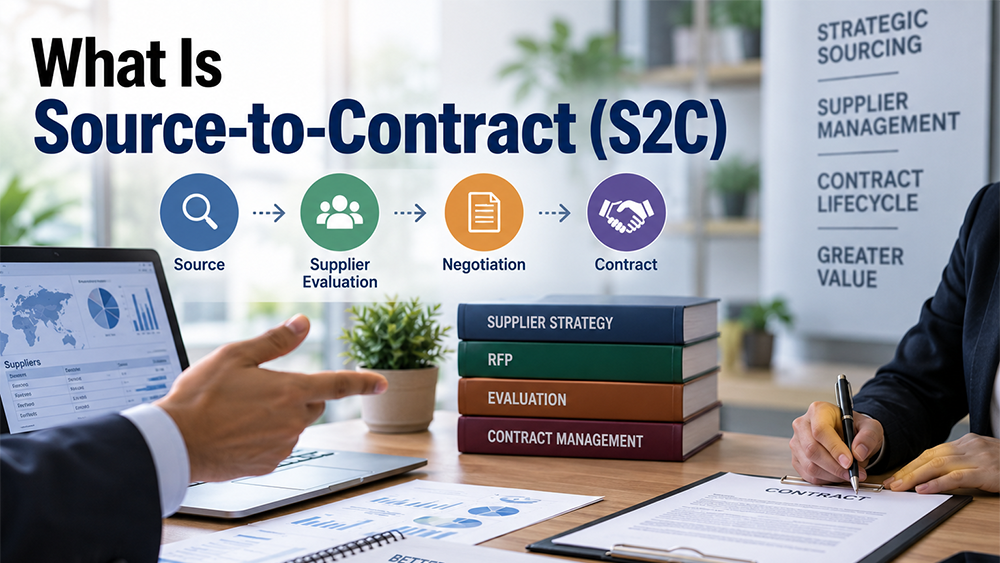
In modern procurement, businesses need more than simply finding suppliers and negotiating prices. They need a structured process to identify sourcing opportunities, evaluate suppliers, negotiate contracts, and manage agreements efficiently. This is where Source-to-Contract (S2C) comes into play.
Source-to-Contract (S2C) is a procurement process that covers activities from identifying a sourcing requirement to selecting suppliers, negotiating terms, creating contracts, and finalising supplier agreements. It helps organisations improve cost savings, supplier management, compliance, transparency, and procurement efficiency.
With the growing adoption of digital procurement software, AI-powered procurement, e-sourcing platforms, and procurement automation, S2C has become an important part of strategic procurement management. This guide explains what Source-to-Contract means, the S2C process, key steps, benefits, challenges, and the difference between S2C and Procure-to-Pay (P2P).
What Is Source-to-Contract (S2C)?
Source-to-Contract (S2C) is the end-to-end procurement process used to identify business requirements, find and evaluate suppliers, conduct sourcing activities, negotiate commercial terms, and create supplier contracts. In simple terms:
Source-to-Contract = Requirement → Sourcing → Supplier Selection → Negotiation → Contract
The objective of S2C is to help organisations make better sourcing decisions while achieving competitive pricing, reducing procurement risks, improving supplier relationships, and ensuring contractual compliance.
Also read: What Is a Centralized Procurement System? Process, Advantages, and Examples (2026 Guide)
Source-to-Contract Meaning in Procurement
The Source-to-Contract meaning in procurement refers to the complete strategic sourcing lifecycle that takes place from the identification of a sourcing requirement through the creation and management of a supplier contract. For example, suppose a manufacturing company needs to purchase raw materials worth ₹1 crore annually.
The S2C process may involve:
- Identifying the requirement.
- Analysing historical spend.
- Defining sourcing specifications.
- Identifying potential suppliers.
- Inviting suppliers to participate in an RFQ or RFP.
- Comparing supplier bids.
- Evaluating suppliers.
- Negotiating price and commercial terms.
- Selecting the preferred supplier.
- Creating and approving the contract.
- Monitoring contractual terms and supplier performance.
What Is the Source-to-Contract Process?
The Source-to-Contract process consists of several interconnected stages. While the exact workflow can vary between organisations, a typical S2C process includes the following steps:
Spend Analysis → Requirement Definition → Supplier Discovery → Supplier Qualification → RFx → Bid Evaluation → Negotiation → Supplier Selection → Contract Creation → Contract Management Let's understand each stage in detail.
1. Spend Analysis
The first step in the S2C process is understanding where and how the organisation is spending money. Procurement teams analyse historical purchasing data to identify:
- Total category spend
- Supplier-wise spending
- Product or service categories
- Pricing trends
- Contracted and non-contracted spend
- Maverick spend
- Potential cost-saving opportunities
Spend analysis helps procurement teams understand purchasing patterns and identify categories where strategic sourcing can generate savings. For example, if a company purchases the same packaging material from multiple suppliers at different prices, spend analysis can reveal an opportunity for supplier consolidation and better pricing.
2. Requirement Identification and Definition
After analysing spend, the organisation needs to clearly define what it wants to purchase. This stage involves documenting:
- Product or service specifications
- Required quantity
- Quality standards
- Delivery requirements
- Budget
- Service-level expectations
- Compliance requirements
- Technical specifications
Clearly defining requirements helps procurement teams communicate expectations to suppliers and compare supplier proposals more effectively.
3. Supplier Discovery
Once requirements are established, procurement teams identify potential suppliers. Supplier discovery may involve:
- Existing supplier databases
- Supplier marketplaces
- Industry directories
- Supplier recommendations
- Market research
- Supplier onboarding platforms
- Procurement networks
The objective is to create a pool of qualified suppliers capable of meeting the organisation's requirements.
4. Supplier Qualification
Not every supplier identified during supplier discovery will be suitable. Procurement teams therefore evaluate suppliers based on factors such as:
- Financial stability
- Product quality
- Manufacturing capabilities
- Certifications
- Production capacity
- Delivery performance
- Geographic coverage
- Compliance
- Past performance
- Pricing competitiveness
Organisations may use a Supplier Qualification Questionnaire (SQQ) or Request for Information (RFI) to collect supplier information.
This step helps reduce supplier risk before moving into competitive sourcing.
5. RFx and E-Sourcing
The next stage involves conducting a formal sourcing event.
Depending on the requirement, procurement teams may use different types of RFx:
RFI – Request for Information
An RFI is used to gather information about suppliers, products, services, capabilities, and market conditions.
RFQ – Request for Quotation
An RFQ is generally used when the specifications are clearly defined and suppliers are primarily being compared on price and commercial terms.
RFP – Request for Proposal
An RFP is used for more complex requirements where suppliers need to propose a combination of products, services, technical solutions, pricing, and implementation approaches.
Digital e-sourcing software can help procurement teams create, manage, and track these sourcing events.
6. Bid Collection and Evaluation
After an RFQ, RFP, or other sourcing event is launched, suppliers submit their proposals. Procurement teams evaluate bids based on predefined criteria, including:
- Price
- Quality
- Delivery timeline
- Technical specifications
- Payment terms
- Warranty
- Supplier capabilities
- Compliance
- Total cost of ownership
Instead of selecting the supplier offering the lowest price alone, organisations can evaluate the overall commercial and strategic value of each proposal.
7. Supplier Comparison and Selection
Once bids are evaluated, procurement teams compare qualified suppliers. A supplier evaluation matrix can be used to assign scores to different criteria.
For example:
Evaluation Criteria | Weight |
Price | 30% |
Product Quality | 20% |
Delivery Capability | 15% |
Technical Capability | 15% |
Supplier Experience | 10% |
Compliance | 10% |
The weighted evaluation helps procurement teams make more objective and transparent supplier decisions.
8. Negotiation
Negotiation is a critical stage of the Source-to-Contract process. Procurement teams negotiate with shortlisted suppliers on factors such as:
- Unit price
- Volume discounts
- Payment terms
- Delivery schedules
- Minimum order quantities
- Warranty
- Service levels
- Penalties
- Incoterms
- Contract duration
- Price escalation clauses
Digital procurement platforms may also support e-auctions and online negotiations, allowing buyers to improve price competitiveness and transparency.
9. Supplier Selection and Award
After negotiations, the procurement team selects the supplier or suppliers that best meet the organisation's requirements. The decision should consider the complete value proposition rather than price alone. Depending on the category, organisations may select:
- A single strategic supplier
- Multiple suppliers
- Primary and backup suppliers
- Regional suppliers
- Specialised suppliers
The sourcing decision is then formally approved according to the organisation's procurement policies.
10. Contract Creation
After supplier selection, the agreed commercial and operational terms are converted into a formal contract. A procurement contract may include:
- Supplier and buyer details
- Product or service scope
- Pricing
- Payment terms
- Delivery conditions
- Quality requirements
- Service-level agreements
- Warranty
- Confidentiality
- Compliance requirements
- Contract duration
- Renewal terms
- Termination conditions
- Dispute resolution
- Performance obligations
Contract management software can help procurement and legal teams create, review, approve, store, and manage contracts digitally.
11. Contract Approval
Before the contract becomes effective, it typically goes through an internal approval workflow. Depending on the organisation, approvals may involve:
- Procurement
- Finance
- Legal
- Operations
- Business stakeholders
- Senior management
Automated approval workflows can reduce delays and provide better visibility into contract status.
12. Contract Execution
Once all required stakeholders approve the agreement, the contract is executed by the authorised parties. Digital procurement systems may support:
- Electronic signatures
- Digital document storage
- Contract version control
- Approval tracking
- Audit trails
This creates a centralised record of the agreement and reduces dependency on manual documentation.
13. Contract Management
The S2C process does not end when the contract is signed. Contract management ensures that both parties comply with the agreed terms throughout the contract lifecycle. Procurement teams may monitor:
- Contract expiry dates
- Renewal dates
- Pricing
- Supplier performance
- Service-level agreements
- Contract utilisation
- Compliance
- Savings
- Penalties
- Obligations
Effective contract management helps organisations capture the value negotiated during sourcing.
Also read: Top 10 Best AI Procurement Software In 2026: Features, Applications & Comparison
Key Components of Source-to-Contract
The S2C lifecycle typically includes several procurement functions.
Strategic Sourcing: Strategic sourcing focuses on identifying suppliers and purchasing strategies that deliver the best combination of cost, quality, availability, and risk management.
Supplier Management: Supplier management involves identifying, qualifying, onboarding, evaluating, and maintaining supplier relationships.
E-Sourcing: E-sourcing digitises sourcing activities such as RFIs, RFQs, RFPs, bid collection, supplier comparison, and e-auctions.
Contract Management: Contract management covers contract creation, negotiation, approval, execution, storage, monitoring, renewal, and closure.
Spend Analytics: Spend analytics provides visibility into organisational spending and helps identify cost optimisation opportunities.
Procurement Analytics: Procurement analytics uses procurement data to measure supplier performance, savings, sourcing outcomes, category performance, and procurement efficiency.
What are the Benefits of Source-to-Contract?
Implementing a structured S2C process can provide several benefits to organisations.
1. Cost Savings: Strategic sourcing, competitive bidding, supplier consolidation, and negotiation can help organisations reduce procurement costs.
2. Better Supplier Selection: Structured supplier evaluation enables procurement teams to select suppliers based on multiple factors instead of price alone.
3. Improved Procurement Efficiency: Automating sourcing, approvals, supplier evaluation, and contract workflows reduces manual effort.
4. Better Spend Visibility: Spend analytics provides a clearer view of where money is being spent and which categories have optimisation opportunities.
5. Reduced Procurement Risk: Supplier qualification and contract controls help organisations identify and manage supplier, financial, compliance, and operational risks.
6. Improved Contract Compliance: Centralised contract management helps procurement teams monitor negotiated terms and identify deviations.
7. Better Supplier Relationships: A transparent sourcing and contract management process can improve communication and collaboration with suppliers.
8. Increased Transparency: Digital sourcing platforms create records of bids, evaluations, approvals, negotiations, and contracts, supporting better auditability.
Source-to-Contract vs Procure-to-Pay
Source-to-Contract (S2C) and Procure-to-Pay (P2P) are two important procurement processes, but they focus on different stages of procurement.
Parameter | Source-to-Contract (S2C) | Procure-to-Pay (P2P) |
Primary focus | Strategic sourcing and contracting | Purchasing and payment |
Starting point | Sourcing requirement | Purchase requisition |
Key activities | Sourcing, RFx, negotiation, supplier selection, contracts | Requisition, PO, receipt, invoice, payment |
Main objective | Obtain the best supplier and commercial terms | Complete the purchase-to-payment cycle |
Supplier interaction | High | Transactional |
Major tools | E-sourcing and contract management | Purchasing and accounts payable systems |
End point | Executed/managed contract | Supplier payment |
Role of Technology in Source-to-Contract
Traditional S2C processes often depend on spreadsheets, emails, physical documents, and disconnected systems. These methods can create delays and make procurement data difficult to track. Modern procurement software can digitise multiple S2C activities, including:
- Spend analysis
- Supplier discovery
- Supplier onboarding
- Supplier qualification
- RFQ/RFP management
- Bid comparison
- E-auctions
- Negotiation
- Contract management
- Approval workflows
- Supplier performance tracking
- Procurement analytics
AI can further support procurement teams by helping analyse large volumes of procurement data, identify patterns, compare supplier information, automate repetitive activities, and generate insights for better sourcing decisions.
Conclusion
Source-to-Contract (S2C) is an end-to-end strategic procurement process that helps organisations manage everything from sourcing requirements and supplier discovery to negotiations, supplier selection, contract creation, and contract management. A well-designed S2C process can help businesses achieve better cost control, supplier performance, procurement transparency, contract compliance, risk management, and operational efficiency.
As businesses adopt digital procurement platforms, AI-powered procurement software, e-sourcing, procurement analytics, and automated contract management, S2C is becoming increasingly important for building a connected and data-driven procurement function. Ultimately, the goal of S2C is simple: find the right suppliers, negotiate the right terms, create effective contracts, and ensure the value agreed during sourcing is delivered throughout the supplier relationship.
Frequently Asked Questions About Source-to-Contract
What is Source-to-Contract (S2C)?
Source-to-Contract is the procurement lifecycle that covers activities from identifying a sourcing requirement through supplier discovery, evaluation, negotiation, selection, contract creation, approval, and contract management.
What are the main steps in S2C?
The main S2C steps include spend analysis, requirement definition, supplier discovery, supplier qualification, RFx, bid evaluation, negotiation, supplier selection, contract creation, approval, execution, and contract management.
What is the difference between S2C and P2P?
S2C focuses on strategic sourcing and contracts, while P2P manages transactional purchasing activities from requisition and purchase order creation through goods receipt, invoice processing, and supplier payment.
What is an S2C platform?
An S2C platform is procurement software designed to digitise and manage strategic sourcing, supplier management, RFx, negotiations, contract management, and related procurement workflows.
How does S2C reduce procurement costs?
S2C can reduce costs through competitive sourcing, supplier comparison, negotiation, supplier consolidation, spend analysis, contract compliance, and identification of savings opportunities.
Can AI be used in Source-to-Contract?
Yes. AI can support S2C activities such as spend analysis, supplier evaluation, document analysis, sourcing insights, contract analysis, risk identification, and procurement decision-making.

Pradeep Mehra
About the Author: Pradeep Mehra is a passionate content strategist and B2B technology writer with a deep understanding of industrial procurement, e-commerce, and digital transformation. With years of experience in crafting research-backed articles, marketing copies, and brand stories, he specializes in making complex topics like AI in procurement, supply chain automation, fintech, and industrial product innovation easy to understand and engaging to read. Beyond his writing, Pradeep is driven by a passion for discovering market insights and building digital communication strategies that strengthen brand connections.