






Published: November 10, 2026
Demand Planning vs Demand Forecasting: What’s the Difference?
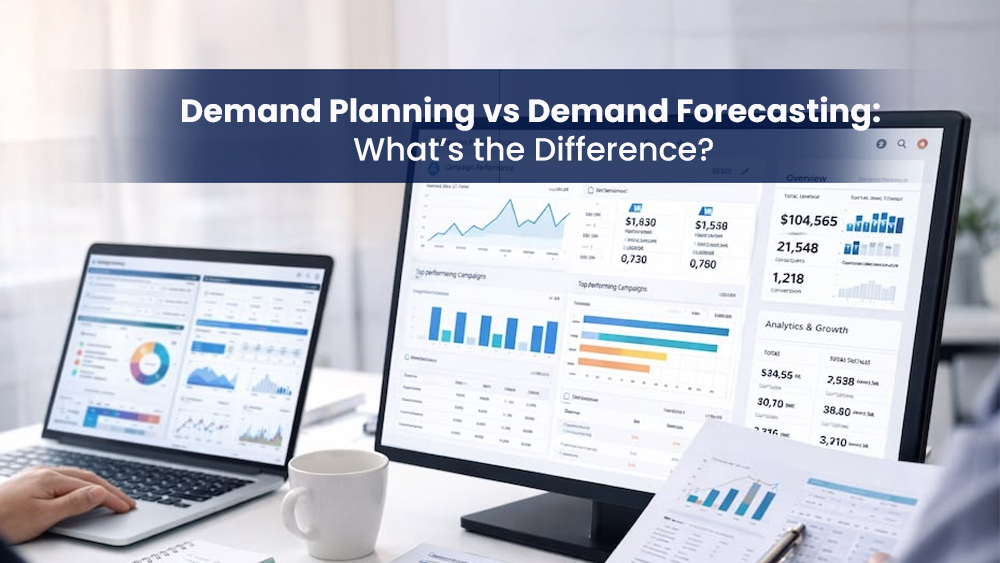
In the competitive world of modern business, being able to predict demand is an important part of managing your inventory. However, many businesses can get confused between demand planning and demand forecasting. Demand forecasting will give you an idea of how much of a product you expect to sell in the future. Demand planning uses this forecast, along with your business goals and insights to decide how to best meet demand. By understanding the differences between demand planning and demand forecasting, you can minimise stock-outs, avoid overstocking products, and make better purchasing decisions to have a more resilient supply chain. In this blog we’ll take a look at what each term means, what the differences are, why it can be beneficial to your business, and look at some examples.
What Do You Understand By Demand Forecasting?
Demand Forecasting is a technique that uses past sales data to predict how much customers will want in the future. It allows businesses to plan how much stock they may need over a certain time frame. For example if a manufacturing business looks at their past data and market trends, they may predict they will need 10,000 units of a product next month so they can plan their stock and buying.
Understand The Major Components Of Demand Forecasting
- Historical sales data – This looks at past sales patterns.
- Market trends – Looks at trends in customer behaviour, demand within the industry and competitor activity.
- Seasonality – Looking at changes in demand due to festival periods, holidays, changes in weather and high shopping periods.
- Statistical Models – Time-series and other forecasting methods are used to predict future demand levels.
- AI and Machine Learning – Complex patterns can be identified using large sets of data to improve forecast accuracy.
Benefits of Demand Forecasting
- It helps in improving the overall planning of inventory and replenishment decisions.
- Better anticipation of seasonal demand and fluctuation structure.
- Reduces the overall burden of procurement and production scheduling
- Creates a proper structure for resource allocation and budgeting.
What Is Demand Planning?
Demand planning is a broader business process that combines demand forecasts with inventory levels, procurement capabilities, production capacity, sales targets, and market intelligence to create an actionable plan for meeting customer demand. While forecasting estimates what customers may buy, demand planning determines how the business can prepare to fulfil those requirements efficiently. For example, if a demand forecast predicts sales of 10,000 units next month, the demand planning team evaluates current stock, supplier lead times, production capacity, and budget constraints. Based on this analysis, the team may decide to procure additional raw materials, adjust production schedules, or redistribute inventory across warehouses.
Key Components of Demand Planning
- Demand forecast analysis: Uses projected demand as the starting point for business planning.
- Inventory management: Determines appropriate stock levels to meet expected demand.
- Procurement planning: Aligns purchasing schedules with material requirements and supplier lead times.
- Production planning: Coordinates manufacturing capacity with anticipated sales.
- Sales and operations planning (S&OP): Aligns sales, finance, procurement, and operations teams.
- Continuous monitoring: Updates plans as actual demand, inventory availability, or market conditions change.
Benefits of Demand Planning
- Aligns inventory, procurement, and production with business requirements.
- Improves collaboration between sales, finance, and supply chain teams.
- Helps optimise working capital by reducing excess inventory.
- Supports supplier coordination and purchasing decisions.
- Improves order fulfilment and customer satisfaction.
Demand Planning vs Demand Forecasting: Key Differences
Although demand planning and demand forecasting are closely connected, they differ in their objectives, scope, processes, and business outcomes.
Comparison Factor | Demand Forecasting | Demand Planning |
Meaning | Estimates future customer demand | Creates an actionable plan to meet expected demand |
Primary objective | Predict future sales or product requirements | Balance demand with supply and business capabilities |
Scope | Focuses mainly on demand estimation | Covers forecasting, inventory, procurement, production, and coordination |
Key inputs | Historical sales, market trends, seasonality, and customer behaviour | Forecasts, inventory data, supplier capacity, lead times, budgets, and business goals |
Main activities | Data analysis, trend identification, and predictive modelling | Resource allocation, purchasing decisions, production scheduling, and inventory planning |
Key stakeholders | Demand analysts, sales teams, and data analysts | Supply chain, procurement, finance, sales, and operations teams |
Technology | Statistical forecasting tools and predictive analytics | Supply chain planning systems, ERP platforms, and integrated planning tools |
Primary output | Demand estimates | Actionable supply and inventory plans |
Success metrics | Forecast accuracy and forecast bias | Service levels, inventory turnover, stock availability, and plan adherence |
In simple terms: Demand forecasting predicts what customers may need, whereas demand planning determines how the business will meet that need.
Demand Planning vs Demand Forecasting: Examples
Consider a manufacturing company that supplies electrical components to industrial buyers.
The company expects demand to increase before a major seasonal sales period. Both demand forecasting and demand planning play an important role in preparing for this increase.
Example 1: Demand Forecasting
The company reviews its sales history, recent order volumes, seasonal patterns, and market trends. Based on this analysis, it forecasts demand for 15,000 electrical components over the next month.
This estimate helps the company understand how many units customers are likely to purchase.
Example 2: Demand Planning
After receiving the forecast, the company reviews its available inventory, supplier lead times, production capacity, and procurement budget. The team discovers that only 6,000 units are available in stock. It then plans to procure or manufacture the remaining 9,000 units, subject to confirmed requirements and operational constraints. It may also schedule deliveries, coordinate with suppliers, and allocate stock across warehouses. The forecast provides the demand estimate, while the plan translates that estimate into purchasing, production, and inventory decisions.
Why Are Demand Planning and Demand Forecasting Important for Supply Chain Management?
Demand planning and demand forecasting are essential for businesses that want to improve supply chain efficiency, control costs, and respond quickly to changing customer needs.
Here’s how they contribute to better supply chain management.
1. Improve Inventory Management
Accurate forecasts help businesses estimate future stock requirements, while demand planning determines appropriate inventory levels based on actual stock, lead times, and service-level targets. This helps reduce excess inventory, prevent stockouts, and improve inventory turnover.
2. Optimise Procurement Decisions
Demand forecasting helps procurement teams anticipate material requirements. Demand planning translates these estimates into purchasing schedules and supplier commitments. For example, a procurement team can use planned requirements to consolidate orders, negotiate bulk pricing, and coordinate deliveries with production schedules.
3. Reduce Supply Chain Costs
Poor demand estimates can lead to unnecessary purchases, emergency shipments, excess storage costs, and production delays. By combining forecasting with demand planning, businesses can make more informed purchasing decisions, allocate resources efficiently, and reduce avoidable supply chain expenses.
4. Improve Supplier Coordination
Demand planning enables businesses to share anticipated requirements with suppliers and align purchasing schedules with supplier capacity and lead times. This is particularly important for manufacturers and B2B companies that depend on multiple suppliers for critical raw materials and components.
5. Enhance Customer Satisfaction
When businesses anticipate demand accurately and plan inventory effectively, they are better positioned to fulfil orders on time. This improves product availability, reduces delivery delays, and creates a more reliable customer experience.
Common Demand Forecasting Methods
Businesses can use different demand forecasting methods depending on data availability, product characteristics, and planning requirements.
- Qualitative forecasting: Uses expert opinions, customer feedback, market research, and sales team insights when historical data is limited.
- Time-series forecasting: Analyzes historical demand patterns to estimate future demand.
- Causal forecasting: Evaluates relationships between demand and factors such as price, promotions, economic conditions, and market activity.
- AI-powered forecasting: Uses machine learning to identify complex patterns across sales, inventory, customer, and market data.
- Seasonal forecasting: Accounts for recurring demand fluctuations during specific months, holidays, or business cycles.
Many businesses combine multiple methods to improve forecast reliability and account for changing market conditions.
How Does Technology Improve Demand Planning and Demand Forecasting?
Modern supply chain technology helps businesses improve visibility, automate repetitive tasks, and make data-driven decisions.
AI-powered forecasting tools can analyse large datasets, identify demand patterns, and generate updated predictions. Integrated planning systems can then combine these forecasts with inventory, procurement, and production data to support operational decisions.
For example, if demand for a particular component increases unexpectedly, an integrated system can help planners identify potential stock shortages, review supplier lead times, and adjust purchasing requirements. However, technology does not eliminate uncertainty. Forecast quality still depends on data accuracy, model suitability, and the ability of teams to respond to changing conditions.
Conclusion
Understanding demand planning vs demand forecasting is essential for building an efficient and responsive supply chain. Demand forecasting estimates future customer requirements, while demand planning turns those estimates into decisions about procurement, inventory, production, and resource allocation. Together, these processes help businesses reduce inventory costs, improve supplier coordination, minimise stock shortages, and fulfil customer orders more efficiently. For businesses managing complex procurement operations, they can simply collaborate with Cognilix, which helps combine reliable demand forecasts with integrated planning systems that improve visibility and support better purchasing decisions. The key is to treat forecasting and planning as connected processes that are reviewed and refined as business conditions change.