






Published: May 6, 2026|Author: Pradeep Mehra
What Is ABC Analysis in Inventory Management - Importance, Formula, and Examples
When it comes to inventory management, every business seeks an appropriate and proper management strategy to deal with the entire process effortlessly. Whether it involves managing a wholesale business, e-commerce stock, or a manufacturing unit, proper analysis is required to optimize inventory and enhance profitability. So, among all types of strategies, ABC analysis of inventory is one of the best techniques, widely used by many businesses.
Implementing inventory management has become more than just an operational task, which directly influences the company’s profitability, customer satisfaction, and cash flow. Therefore, implementing the ABC classification in inventory control avoids situations like overstocking, holding costs, and product obsolescence. Therefore, to manage your stock and inventory, ABC inventory management helps in optimizing the cost and improving services level. In this comprehensive guide, we’ll explore what ABC Analysis is, its importance, formula, practical examples, and how you can implement it for better inventory control.
What Is ABC Analysis?
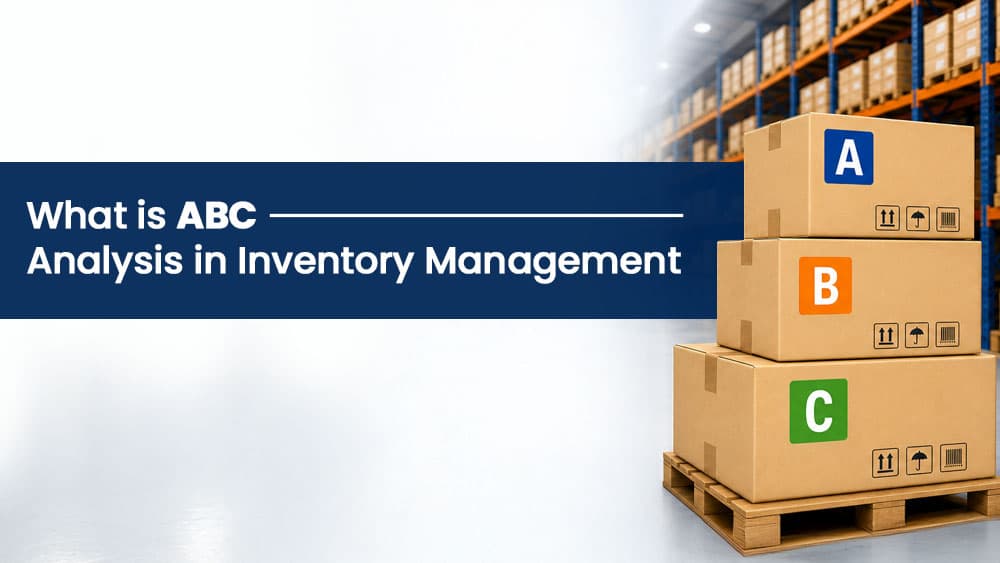
ABC analysis is one of the most prominent methods for inventory management that divides into three categories, which include A, B, and C. These categories are known for their specific importance, which helps in measuring the values and contribution to the overall inventory cost.
Delving more into its principles, it works on the 80/20 rule, which suggests that even a small percentage of items can simply contribute in majority of cost savings.
Categories in ABC Analysis:
- Category A (High Value, Low Quantity): The items falling into the category of “A” mostly contribute a bigger percentage of revenue, but are fewer in number. Therefore, this category requires strict monitoring and tracking.
- Category B (Moderate Value, Moderate Quantity): In this category, the items available contribute in a balanced way and require moderate attention.
- Category C (Low Value, High Quantity): These are low-cost items but large in number. They need simple controls and less monitoring.
What is the Importance of ABC Analysis in Inventory Management?
ABC analysis in stock control and inventory management has always been one of the most effective and efficient strategies for improving business growth plus productivity.
1. Better Inventory Control: Categorization of various items based on their importance and priority helps you avoid overstocking and stockouts.
2. Cost Optimization: ABC analysis also helps in decreasing the carrying cost by properly aligning the stock levels, mainly focusing on high-value items.
3. Improved Decision Making: The management team can make reliable and informed decisions while purchasing, stocking, and pricing items based on the classification.
4. Efficient Resource Allocation: The ABC method of inventory control helps in systematic allocation of stocks, which saves time, effort, and other resources.
5. Reduced Risk of Loss: High-value items are monitored closely, reducing risks like theft, damage, or obsolescence.
Let’s Understand the ABC Analysis Formula
For a more comprehensive understanding, we provided you with an elaborate formula for ABC analysis.
Step-by-Step Formula:
- Annual Consumption Value = Annual Demand × Cost per Unit
- List all inventory items and calculate their annual consumption value.
- Sort items in descending order of consumption value.
- Calculate the cumulative percentage of the total value.
- Classify items:
- Top 70 - 80% value - Category A
- Next 15 - 25% value - Category B
- Remaining 5 - 10% value - Category C
Quick Look at The Example of ABC Analysis
Let’s understand ABC Analysis with a simple example:
Item | Annual Demand | Cost per Unit (₹) | Consumption Value (₹) |
Item 1 | 100 | 500 | 50,000 |
Item 2 | 200 | 200 | 40,000 |
Item 3 | 500 | 50 | 25,000 |
Item 4 | 1000 | 10 | 10,000 |
Item 5 | 2000 | 5 | 10,000 |
Step 1: Arrange in Descending Order
- Item 1 - 50,000
- Item 2 - 40,000
- Item 3 - 25,000
- Item 4 - 10,000
- Item 5 - 10,000
Step 2: Calculate Total Value
Total = ₹1,35,000
Step 3: Categorize
- Category A: Item 1, Item 2 (highest value contribution - 67%)
- Category B: Item 3 (18%)
- Category C: Item 4, Item 5 (15%)
Key Characteristics of ABC Categories
Category | Value Contribution | Number of Items | Control Level |
A | High (70 - 80%) | Low (10 - 20%) | Very Strict |
B | Medium (15 - 25%) | Moderate (20 - 30%) | Moderate |
C | Low (5 - 10%) | High (50 - 70%) | Basic |
How to Implement ABC Analysis?
1. Collect Inventory Data: The very first step is to collect all essential details of items, such as cost, annual demand, and usage frequency.
2. Calculate Consumption Value: Next, businesses need to use the aforementioned formula to compute the annual value.
3. Sort and Rank Items: Based on the above formula, it becomes easier to classify the items from highest to lowest.
4. Classify into A, B, C: the outcome derived from the formula; the items are classified and divided based on cumulative percentages.
5. Apply Control Strategies: After division of items, you need to follow the following strategy:
- Tight control for A items
- Periodic review for B items
- Simple controls for C items
What Are the Advantages of Implementing ABC Analysis for Inventory Management?
ABC analysis has been a productive and efficient method for inventory management. It has multiple advantages, such as:
- Improves Inventory Turnover: ABC analysis assists businesses in prioritizing the important category of items, like category A, ensuring every item is sold on time and replenished quickly.
- Reduces Excess Stock: Through this efficient strategy, businesses can avoid the chances of overstocking by identifying the low-priority items, which fall into category C.
- Enhances Cash Flow Management: It also ensures that the capital is appropriately invested in the right and valuable items, and even focuses on fast-moving items with a lower impact on stocks.
- Simplifies Inventory Tracking: Systematic categorization of inventory into A, B, and C makes it easier for businesses to manage the items based on their importance.
- Increases Operational Efficiency: Resources, time, and effort are allocated based on item importance and value. This leads to better productivity and more streamlined inventory operations.
What are the Limitations of ABC Analysis?
While ABC Analysis is powerful, it has some limitations:
- Ignores demand variability
- Doesn’t consider lead time
- Not suitable for all industries
- Requires regular updates
To avoid such issues, which are due to manual processes, businesses can implement a cutting-edge and AI-powered inventory management and optimization tool. You can partner with Cognilix, India's one of the best B2B SaaS procurement platforms, providing a reliable and automated solution and tools.
Conclusion
Inventory management is the priority and most important part of any business. To manage the complete cycle of stock and inventory control can be easily managed through a reliable method called ABC analysis. It is a powerful and effective approach for business where items are compiled in different categories, such as A, B, and C. Based on importance, you can simply focus on the high-value items and control the inventory precisely. However the latest technology and AI evolution, you can implement inventory management tools like Cogniplan by partnering with Cognilix for better and smart control of your inventory.
FAQs
What are the 4 types of inventory?
The four main types are Raw Materials, Work-in-Progress (WIP), Finished Goods, and MRO (Maintenance, Repair, and Operations) inventory. Each type represents a different stage in the production and supply chain process.
What is EOQ and ABC analysis?
EOQ (Economic Order Quantity) is a formula used to determine the optimal order quantity that minimizes total inventory costs. ABC Analysis categorizes inventory into A, B, and C groups based on value and importance for better control.
What does ABC stand for in inventory management?
ABC stands for Always Better Control, focusing on prioritizing high-value inventory items. It divides items into A (high value), B (moderate), and C (low value) categories.
What is an example of an ABC analysis?
‘A’ items include high-value, low-quantity goods like electronics or machinery parts. ‘C’ items are low-value, high-quantity goods like office supplies, while ‘B’ items fall in between.

Pradeep Mehra
About the Author: Pradeep Mehra is a passionate content strategist and B2B technology writer with a deep understanding of industrial procurement, e-commerce, and digital transformation. With years of experience in crafting research-backed articles, marketing copies, and brand stories, he specializes in making complex topics like AI in procurement, supply chain automation, fintech, and industrial product innovation easy to understand and engaging to read. Beyond his writing, Pradeep is driven by a passion for discovering market insights and building digital communication strategies that strengthen brand connections.