






Published: April 28, 2026|Author: Pradeep Mehra
How Delivery Management System Works: A Complete Guide
As the market is becoming hypercompetitive and focusing on elevating the convenience of customers, delivery is not just a normal operation. Every day, businesses are putting efforts into improving their delivery system, whether it is B2B, B2C, or D2C. By improving the shipment cycle, it not only improves satisfaction but also builds trust and relationships with customers, which leads to a better retention rate. Here comes the improvement of the delivery management system, which simplifies the shipment or delivery cycle overall.
A well-equipped DMS not only manages the shipment but also helps in reducing the cost, improving customer satisfaction, and enabling businesses to scale more quickly and smartly. Therefore, it becomes pivotal to find the best delivery management software that elevates the entire delivery cycle. Through this blog, we will come to know about the importance, framework, and best delivery management software.
What is a Delivery Management System?
A delivery management system is an advanced platform for businesses to improve overall shipment, which helps in managing, tracking, and optimizing the entire process from start to end.
It acts as a centralized platform that connects:
- Orders
- Dispatch teams
- Delivery agents
- Customers
Therefore, a delivery management system elevates real-time tracking and leads to intelligent decision-making operations.
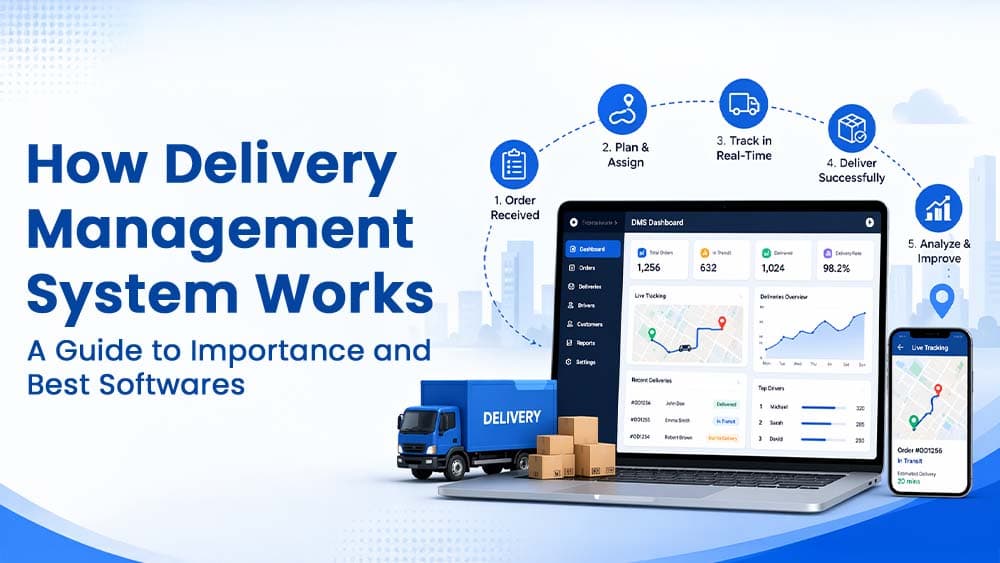
Understand The Comprehensive Work Process of the Delivery Management System
Before incorporating the delivery management system, it is necessary to understand its entire working process.
1. Order Capture and Integration
The process begins when an order is placed through:
- eCommerce websites
- Mobile apps
- POS systems
- Call centers
The DMS integrates with these platforms and automatically captures:
- Customer details
- Delivery address
- Product information
- Delivery time preferences
Why This Step Matters:
- Eliminates manual data entry
- Reduces errors
- Speeds up order processing
2. Order Validation and Prioritization
Before dispatch, the system validates:
- Address accuracy
- Service availability
- Delivery timelines
Once the process is done, the next part is to prioritize
- Urgency of delivery, either the next day or same-day delivery
- Customer type (premium vs regular)
- Delivery location
3. Intelligent Order Assignment
Once validated, the DMS assigns orders to delivery agents using smart algorithms.
Factors Considered:
- Driver’s current location
- Vehicle capacity
- Traffic conditions
- Delivery deadlines
- Driver performance history
Result:
- Faster assignment
- Reduced idle time
- Balanced workload distribution
4. Route Optimization (Core Engine of DMS)
In the entire process, the route optimization step is very crucial to calculate the efficient route for delivery.
This process is done by using
- Real-time traffic data
- Distance between stops
- Delivery time windows
- Road conditions
Key Outcomes:
- Reduced fuel consumption
- Faster deliveries
- Increased number of deliveries per trip
This is especially critical for businesses handling multiple deliveries in a single route (last-mile delivery).
5. Dispatch and Driver Communication
Once the route optimization is done, the software automatically fetches the delivery instructions provided to the drivers through the specified mobile app.
Driver App Features:
- Provides you with appropriate and precise navigation
- Delivery sequence
- Customer contact details
- Real-time updates
Drivers can:
- Accept/reject tasks
- Update delivery status
- Report issues
Impact:
- Smooth coordination
- Reduced confusion
- Improved delivery accuracy
6. Real-Time Tracking and Visibility
A modern DMS offers live tracking capabilities for both businesses and customers.
Features Include:
- GPS tracking of delivery vehicles
- Estimated Time of Arrival (ETA)
- Delivery status updates
Customers receive notifications like:
- “Out for delivery.”
- “Arriving soon”
- “Delivered successfully”
Benefits:
- Builds customer trust
- Reduces support queries
- Improves transparency
7. Proper Completion of Delivery
The delivery agent follows the optimized route and completes the delivery.
The system ensures:
- Timely arrival
- Accurate delivery
- Customer communication
8. Proof of Delivery (POD)
After the delivery is done, the system automatically fetches the details and captures digital proof of the delivery completion.
Common POD Methods:
- OTP verification
- E-signature
- Photo confirmation
Importance:
- Prevents disputes
- Ensures accountability
- Provides legal proof
9. Analytics, Insights, and Reporting
After deliveries are completed, the DMS generates detailed reports.
Key Metrics:
- Delivery success rate
- Average delivery time
- Driver performance
- Cost per delivery
Business Impact:
- Data-driven decision making
- Continuous improvement
- Better planning and forecasting
Understand the Importance of the Delivery Management System
As we all know, delivery management software is created to simplify and automate the whole shipment and supply chain process. However, it has other benefits such as:
1. Enhances Operational Efficiency: Automation replaces manual processes, reducing errors and saving time. Businesses can handle higher delivery volumes with fewer resources.
2. Improves Delivery Speed. With optimized routing and smart dispatching, deliveries become significantly faster, helping meet same-day and instant delivery demands.
3. Reduces Operational Costs: Proper implementation of DMS reduces other costs like fuel expenses, failed deliveries, and labor costs. This augments the
4. Boosts Customer Satisfaction: By improving the timely delivery and real-time tracking improves the retention rates and brand reputation.
5. Enables Scalability: A shipment management system allows businesses to scale faster and improve the efficiency of their operations.
Which is the Best Delivery or Shipment Management Software?
Businesses looking for the top quality, cutting-edge, and reliable shipment management system, then Cognilix is the right platform to partner with. Cognilix works on modern technology to elevate the B2B delivery management system with the integration of AI. It helps businesses to streamline their entire supply chain and shipment process and includes features like managing orders, tracking drivers, and even analyzing with real-time tracking.
Key Features of Cognilix
- Smart Order Management
- AI-Based Route Optimization
- Real-Time Tracking
- Automated Dispatching
- Driver Management
- Proof of Delivery (POD)
- Advanced Analytics
Key Features to Look for in Delivery Management Software
When selecting a DMS, ensure it includes:
- Automated dispatching
- AI-powered route optimization
- Real-time GPS tracking
- Mobile app for drivers
- Multi-delivery handling
- Integration with eCommerce platforms
- Delivery scheduling
- Analytics dashboard
- API integrations
Conclusion
The delivery of products at the right time helps businesses to improve their brand trust, customer satisfaction, and retain users effortlessly. Therefore, opting for a smart and AI-powered delivery or shipment management system becomes necessary to stay ahead of competitors. Cognilix is India's best SaaS B2B solution offering a wide range of cutting-edge and AI powered platform, such as vendor management. So, build a powerful supply chain ecosystem and improve the shopping experience of your customers.

Pradeep Mehra
About the Author: Pradeep Mehra is a passionate content strategist and B2B technology writer with a deep understanding of industrial procurement, e-commerce, and digital transformation. With years of experience in crafting research-backed articles, marketing copies, and brand stories, he specializes in making complex topics like AI in procurement, supply chain automation, fintech, and industrial product innovation easy to understand and engaging to read. Beyond his writing, Pradeep is driven by a passion for discovering market insights and building digital communication strategies that strengthen brand connections.