






Published: May 18, 2026
Different Types of Quotations and How to Manage Them
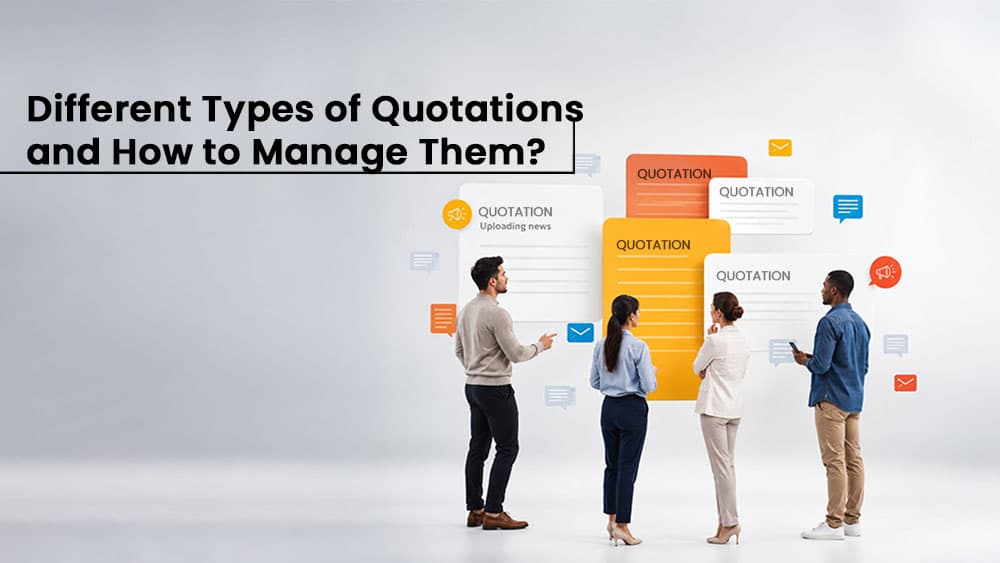
Transactions are an integral and core part of any business, where every individual or team has a keen eye. To enable this process fluently, quotations are released to establish transparency and credibility between buyers and sellers. For various companies and industries like manufacturing hubs, construction businesses, service-based enterprises, and other retail stores, quotation management helps in defining the overall pricing precisely with clear product details and delivery timelines.
However, as companies are growing, it has become necessary to understand the different types of quotations based on the nature of the product, customer requirements, and services. It helps in understanding the right type of quotation suitable for various persons and fulfilling the specific requirement, overall leading to build relationship with customers and improving the sales operation efficiency.
So, through this blog, you will understand the types of quotations in business, their importance, and how to manage them properly to make them efficient.
What Is a Quotation?
A quotation is a formal document that consists of various details about the product and service, such as pricing, quantity, delivery, and timeline, and other terms and conditions for conveying accurate information to the customer and creating healthy relationships with the seller and buyer. So, once it is approved and accepted by the customer end, the quotation becomes the primary foundation for purchase orders, invoices, and contracts.
Importance of Quotations in Business
- Clear description of pricing and product
- Avoid misunderstandings
- Improve professional communication
- Help in budgeting and procurement
- Create legal and financial transparency
- Increase customer confidence
- Support faster decision-making
- Maintain proper business records
What are the Different Types of Quotations in business?
As we already discussed, quotations are primary documents covering every specific information related to any product or service, which leads to a purchase order and invoice once approved by the customer. However, there are various types of quotation helps in achieving the results based on various purposes. Let's have a quick look at them:
Price Quotation
A price quotation plays a major role in showcasing the right pricing structure of a product and service. Additionally, it also consists of unit price, tax details, discount applied or offered, quantity, and total cost of the entire product.
Key Features
- Product pricing details
- Tax calculations
- Discount offers
- Shipping charges
- Payment terms
Best Used For
- Retail businesses
- Wholesale supply
- Manufacturing industries
- E-commerce transactions
Sales Quotation
A sales quotation is the initial phase of the document designed by the seller to showcase the product and service to their potential buyers. It is a collection of transaction details and sales conditions.
Includes
- Product specifications
- Quantity
- Warranty details
- Delivery schedule
- Terms & conditions
Benefits
- Improves sales conversion
- Enhances customer trust
- Simplifies negotiations
Service Quotation
When it comes to service quotation, it is primarily issued for professional and technical services provided to consumers. They do not apply to physical goods or products.
Common Industries
- Digital marketing
- IT services
- Plumbing
- Construction
- Repair & maintenance
- Consultancy services
Includes
- Scope of work
- Service timeline
- Labor charges
- Material costs
- Service terms
Estimate Quotation
To describe and present the estimated pricing or cost of the specific project, an estimate quotation is used. In this scenario, the final pricing may vary depending on the bulk procurement, used materials, and project changes.
Mostly Used In
- Construction projects
- Interior designing
- Engineering work
- Automobile repair
- Renovation services
Advantages
- Helps customers plan budgets
- Offers initial project understanding
- Enables flexible pricing adjustments
Fixed Price Quotation
This type of quotation is offered by the seller to buyers once the final price is fixed and does not change during the entire contract period.
Key Characteristics
- Fixed project cost
- Predefined scope
- No major price fluctuations
- Better cost control
Suitable For
- Government tenders
- Long-term contracts
- Construction agreements
- Software development projects
Proforma Invoice Quotation
It is one of the common and widely used invoicing methods that acts as a preliminary bill shared before the final invoice is generated.
Contains
- Product details
- Estimated pricing
- Shipping information
- Tax details
- Payment instructions
Importance
- Used in international trade
- Helps with customs documentation
- Assists with advance payments
Request for Quotation (RFQ)
An RFQ is not a type of quotation, but it slightly contains the pricing proposal information on request by the buyer.
RFQ Includes
- Product specifications
- Required quantity
- Delivery expectations
- Technical requirements
Used In
- Procurement departments
- Government purchasing
- Manufacturing industries
- Bulk purchasing
Online or Digital Quotation
This is one of the most advanced and latest digital quotations of RFQ software and analytics, which is automatically integrated with the ERP of enterprises or businesses.
Features
- Instant quotation generation
- Automated calculations
- Digital approvals
- Cloud storage
- Real-time tracking
Benefits
- Faster processing
- Reduced paperwork
- Better accuracy
- Improved customer experience
Understand the Key Components of a Professional Quotation
In a complete and comprehensive professional quotation, some major components play a pivotal role in simplifying the invoicing work process for businesses. Let's have a quick look at them:
How To Manage Quotations Effectively?
The most important aspect of any quotation is handling it effectively. Every business needs to focus on the right process to manage quotations ti ensure smooth operations. Let's have a quick look at them:
1. Use Quotation Management Software: You can integrate a powerful and reliable modern ERP and CRM system to automate your entire quotation generation and approval. Also, you can use the RFQ analytics tool to have better command over every transaction.
Popular Features
- Auto-calculations
- Customer database integration
- GST calculation
- Inventory linking
- Real-time status tracking
2. Standardize Quotation Templates: Always opt for the top-notch and standardized quotation format to operate in an efficient and professional environment and process.
Benefits
- Saves time
- Improves branding
- Reduces mistakes
- Simplifies approvals
3. Maintain Proper Version Control: It is necessary to follow the revision practices multiple times to eliminate the probability of errors and to better negotiate.
Best Practices
- Use version numbers
- Track modifications
- Store previous records
- Avoid duplicate quotations
4. Define Clear Terms and Conditions: Mention the genuine information and policies in your quotation to eliminate the probability of discrepancies in the final stage.
Include
- Payment deadlines
- Delivery schedules
- Return policies
- Warranty conditions
- Tax information
5. Track Quotation Status: Your team should be highly active in monitoring every activity and progress of the quotation you generate.
Status Categories
- Draft
- Sent
- Under review
- Approved
- Rejected
- Expired
6. Set Validity Periods: Always mention the exact and clear validity of date and time, to eliminate the market price fluctuations.
Common Validity
- 7 days
- 15 days
- 30 days
7. Store Quotations Digitally: Every quotation you generate should be stored digitally to manage the record in the future.
Advantages
- Easy retrieval
- Better security
- Cloud backup
- Faster audits
- Reduced paperwork
Benefits of Efficient Quotation Management
Proper quotation management offers several business advantages:
- Faster sales cycle
- Improved customer satisfaction
- Better pricing accuracy
- Reduced operational costs
- Increased conversion rates
- Enhanced professionalism
- Stronger supplier and customer relationships
Businesses with organized quotation systems often achieve higher operational efficiency.
Conclusion
Quotations are one of the most important business documents used in procurement, sales, and service management. Different types of quotations, such as price quotations, sales quotations, service quotations, estimate quotations, fixed price quotations, and proforma invoices, serve different business purposes.
Understanding these quotation types and implementing proper quotation management practices can help businesses improve operational efficiency, reduce errors, and build stronger customer relationships. Businesses and enterprises can also use the modern method of invoice and quotation management by opting for quotation software and RFQ analytics tools to simplify and automate the entire process. Cognilix is India's best platform offering AI-powered RFQ analytics tools to streamline the process effortlessly and track every activity with actionable insights.