







Published: September 25, 2026
What Is a Bill of Materials (BOM)? Meaning, Example, Types, and Uses
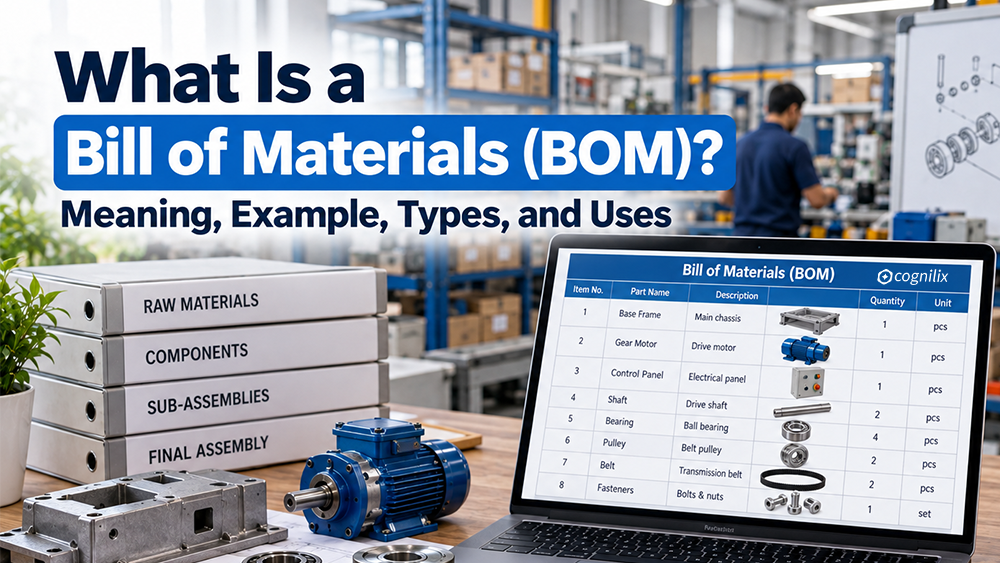
A Bill of Materials (BOM) is a structured list of all the raw materials, components, parts, assemblies, and quantities required to manufacture or assemble a product. It acts as a central reference for procurement, production, inventory management, engineering, and quality teams.
From a simple electronic device to complex industrial machinery, a BOM helps businesses understand what materials are required, how much is needed, and how different components fit together. A well-prepared BOM can improve production planning, reduce material shortages, control costs, and streamline procurement.
In modern manufacturing and procurement, companies increasingly use digital BOM management and procurement software to maintain accurate product structures, track revisions, manage suppliers, and connect BOM requirements with purchasing workflows.
What Is a Bill of Materials (BOM)?
A Bill of Materials (BOM) is a comprehensive inventory of the materials, components, subassemblies, and other items needed to manufacture, assemble, or maintain a finished product.
A BOM generally includes information such as:
- Part or component name
- Part number or SKU
- Required quantity
- Unit of measurement
- Material specifications
- Component description
- Assembly or subassembly information
- Revision or version number
- Supplier information
- Manufacturing or procurement details
The exact structure of a BOM depends on the product, industry, manufacturing process, and business requirements.
BOM Meaning in Manufacturing
In manufacturing, BOM serves as a product blueprint for materials and components. It connects engineering requirements with procurement and production activities.
For example, if a company manufactures an industrial control panel, its BOM may include circuit breakers, contactors, relays, wires, terminals, enclosures, switches, mounting accessories, and other components along with their required quantities. This allows procurement teams to identify materials before production begins and helps manufacturers maintain consistent product quality.
What Is the Purpose of a Bill of Materials?
The primary purpose of a BOM is to provide a standardized and accurate list of everything required to build a product.
A BOM helps organizations:
- Plan material requirements
- Calculate production costs
- Create purchase requirements
- Maintain inventory levels
- Reduce material shortages
- Standardize production
- Improve production planning
- Track product revisions
- Coordinate engineering and procurement teams
- Improve supplier management
- Reduce procurement errors
- Support quality control
By maintaining a centralized BOM, businesses can create better visibility across the product lifecycle.
What Does a Bill of Materials Include?
A BOM can contain different fields depending on the manufacturing process and business requirements. However, a standard BOM usually includes the following information.
1. BOM Level: The BOM level indicates where a component fits within the product hierarchy. Finished products are generally at the top, followed by assemblies, subassemblies, and individual components.
2. Part Number: A unique part number helps identify and track each component or material.
3. Component Name: This specifies the name of the raw material, part, component, assembly, or subassembly.
4. Quantity: The quantity indicates how many units of a particular component are required to manufacture one finished product.
5. Unit of Measure: The unit of measure may include pieces, kilograms, litres, metres, square metres, or other relevant units.
6. Material or Technical Specifications: Technical specifications can describe dimensions, grades, ratings, materials, tolerances, or other requirements.
7. Revision Number: Revision information helps teams identify the latest approved version of a component or product design.
8. Supplier Information: For purchased components, the BOM may include approved suppliers or sourcing information.
9. Notes and Additional Information: Additional details may include manufacturing instructions, quality requirements, assembly notes, or procurement specifications.
Also Read: Top 10 Procure to Pay Software Companies in India 2026
Bill of Materials Example
Consider a company manufacturing a basic industrial control panel.
The BOM for one control panel could contain:
- 1 electrical enclosure
- 1 main circuit breaker
- 3 miniature circuit breakers
- 2 contactors
- 2 overload relays
- 5 control switches
- 10 terminal blocks
- 1 power supply
- 10 metres of control wire
- 20 cable glands
- Mounting hardware and accessories
This BOM provides procurement and production teams with a clear understanding of the materials needed to manufacture one control panel.
If the company needs to manufacture 100 control panels, the required quantity of each component can be calculated based on the BOM, while accounting for inventory, wastage, and production requirements.
Types of Bill of Materials
There are several types of BOM used across manufacturing, engineering, product development, and maintenance. The most common types include the following.
1. Engineering Bill of Materials (EBOM)
An Engineering Bill of Materials (EBOM) is created by engineering and design teams. It focuses on the product structure from a design and technical perspective.
An EBOM generally includes:
- Designed components
- Part numbers
- Technical specifications
- CAD-related information
- Design revisions
- Engineering relationships
EBOMs are commonly used during product development and engineering change management.
2. Manufacturing Bill of Materials (MBOM)
A Manufacturing Bill of Materials (MBOM) describes the materials and components required to manufacture and assemble a product.
Unlike an engineering BOM, an MBOM is organized around the actual manufacturing process.
It can include:
- Raw materials
- Components
- Subassemblies
- Packaging materials
- Manufacturing stages
- Assembly requirements
The MBOM helps production and procurement teams translate product designs into practical manufacturing requirements.
3. Sales Bill of Materials (SBOM)
A Sales Bill of Materials (SBOM) is used when a product is sold as a combination of multiple components or items.
For example, a machine may be sold with standard accessories, installation kits, spare parts, and other components. The sales BOM helps define the complete configuration offered to customers.
4. Service Bill of Materials
A Service BOM is used for maintenance, repair, and servicing activities.
It may contain:
- Replacement parts
- Service components
- Consumables
- Maintenance kits
- Spare parts
Service BOMs are particularly useful for products that require regular maintenance throughout their lifecycle.
5. Production BOM
A Production BOM provides the materials and components needed during production. It supports material planning, purchasing, inventory management, and manufacturing operations.
6. Configurable Bill of Materials
A Configurable BOM is used when a product can be manufactured in different configurations based on customer requirements.
For example, an industrial machine may have different motor capacities, control systems, accessories, or enclosure options. A configurable BOM helps businesses manage these product variations without creating completely separate product structures for every configuration.
Single-Level BOM vs Multi-Level BOM
Single-Level BOM
A single-level BOM lists the components directly required to make a product or assembly. It does not provide detailed information about the components within subassemblies.
Multi-Level BOM
A multi-level BOM provides a complete product hierarchy, including assemblies, subassemblies, and individual components.
Multi-level BOMs are useful for complex products where multiple assemblies and subassemblies are involved.
BOM vs Bill of Quantities (BOQ)
A Bill of Materials and Bill of Quantities (BOQ) both contain material-related information, but they are generally used for different purposes.
A BOM is primarily associated with manufacturing and product assembly. It describes the components and materials required to build a specific product.
A BOQ is commonly used in construction and project-based industries to specify quantities of materials, labour, and other resources required for a project.
The structure and purpose can vary by industry, so businesses should use the format that aligns with their operational requirements.
What are the Uses of Bill of Materials in Business?
A BOM has applications across engineering, manufacturing, procurement, inventory, and maintenance.
Procurement Planning: Procurement teams can use BOM information to determine which components need to be purchased and in what quantities.
This helps streamline sourcing and reduces the possibility of missing critical materials.
Inventory Management: BOMs help organizations estimate material requirements and compare them with available inventory.
This can support better stock planning and reduce both shortages and unnecessary inventory accumulation.
Production Planning: Production teams can use BOM data to determine the materials required for a production order. It also helps coordinate manufacturing activities and material availability.
Cost Estimation: A BOM can help businesses estimate product costs by calculating the cost of raw materials, components, and assemblies. This information can contribute to product pricing and cost-control decisions.
Quality Control: Standardized BOMs help quality teams verify whether the correct components and materials are being used during production.
Product Development: Engineering teams can use BOMs to document product structures and manage component changes during product development.
Maintenance and Repair: Service teams can use BOMs to identify replacement parts and maintenance components required for a particular product or machine.
Also read: Top 10 Quality Control Techniques: Understand Types and Best Methods
How to Create a Bill of Materials
Creating a BOM requires accurate product and component information. A basic process includes the following steps.
Step 1: Identify the Finished Product
Start by defining the product or assembly for which the BOM is being created.
Step 2: List All Components
Identify all raw materials, components, assemblies, subassemblies, and consumables required.
Step 3: Assign Part Numbers
Give each component a unique part number or SKU to simplify tracking.
Step 4: Define Quantities
Specify how many units of each component are required to manufacture one finished product.
Step 5: Add Technical Specifications
Include dimensions, material grades, ratings, tolerances, or other relevant specifications.
Step 6: Organize the BOM Hierarchy
Structure the BOM into finished products, assemblies, subassemblies, and individual components.
Step 7: Add Revision Information
Record the BOM version or revision to ensure teams use the latest approved information.
Step 8: Review and Approve
Engineering, procurement, production, and other relevant teams should review the BOM before it is released for operational use.
Conclusion
A Bill of Materials (BOM) is more than a simple list of components. It provides a structured view of the materials, parts, assemblies, quantities, and specifications required to manufacture, assemble, sell, or maintain a product.
From procurement and inventory management to production planning, product development, costing, and maintenance, BOMs help organizations coordinate critical information across multiple functions. As manufacturing and procurement processes become increasingly digital, integrating BOM data with ERP, inventory, supplier management, and procurement systems can help businesses improve material visibility, reduce manual work, and create more efficient purchasing workflows. Cognilix is a one-stop destination for businesses to automate the entire procurement process through various tools.