






Published: July 3, 2026
Top 10 Quality Control Techniques: Understand Types and Best Methods
Quality is among the most desired and important factors to easily chase and determine the success of your product and services. For a manufacturing and construction business, the procurement of various automotive and machine parts, food products, electronics, materials, and many other elements requires consistency, which helps in reducing the risk of defects amd improve the customer satisfaction and increasing profitability.
Here comes the importance of quality control (QC), which is a set of systematic protocols and proces which consist of various elements like inspecting, testing, and minitpring the evey product to ensure they meet the industry and their own quality standards, Modern industries use various quality control techniques to identify defects, minimize waste, improve production efficiency, and comply with international standards such as ISO 9001.
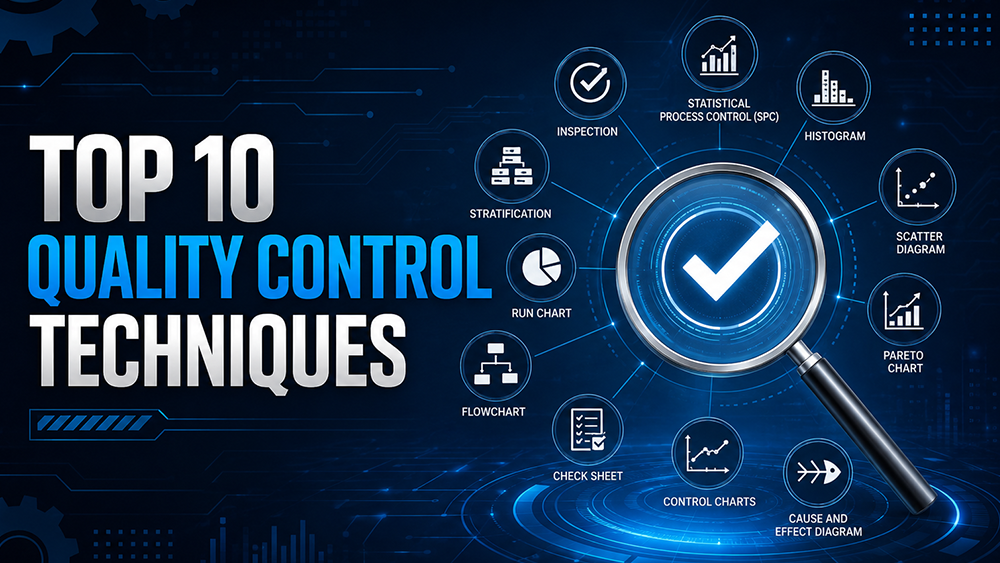
Through this blog, we have provided you with the top 10 quality control techniques or methods that can help you in successfully analyzing the application, advantages, and limitations of products, and finally drive a profitable and sustainable business.
What is Quality Control?
Quality control is a reliable process that contains various aspects, such as examining, testing, and verifying various goods before manufacturing and procurement to ensure all products meet the high-quality standards. The prime goals of this process are to:
- Detect defects early
- Reduce production errors
- Improve product consistency
- Lower manufacturing costs
- Increase customer satisfaction
- Ensure regulatory compliance
What Are The Various Types Of Quality Control
Before we directly talk about the quality control strategies, you need to understand the various types of quality control, such as:
1. Incoming Quality Control (IQC): This is a proper analysis and examination of raw material and purchased products before production begins. Examples:
Steel quality inspection
Plastic resin testing
Electronic component verification
2. In-Process Quality Control (IPQC): This is the process where monitoring of products is performed during the production and manufacturing process. Benefits include:
Early defect detection
Reduced scrap
Lower rework costs
3. Final Quality Control (FQC): Once the product is read and ready to be procured by various buyers, the final inspection is conducted precisely. Typical checks include:
Product dimensions
Functional testing
Visual inspection
Packaging quality
4. Outgoing Quality Control (OQC): The final verification of the product is done before the product is shipped to the various customers.
Quick Look at The Top 10 Quality Control Methods
We have provided a comprehensive overview of the most popular methods for trolling the quality in overall aspects.
1. Statistical Process Control (SPC)
Statistical Process Control is one of the most widely used quality control techniques. It uses statistical methods to monitor manufacturing processes and identify variations before defects occur.
Common SPC Tools
- Control charts
- Process capability analysis
- Histograms
- Run charts
Advantages
- Prevents defects
- Reduces production variation
- Improves consistency
- Supports data-driven decisions
Best For
- Automotive manufacturing
- Electronics
- Pharmaceutical production
- Food processing
2. Six Sigma
Six Sigma is a structured quality improvement methodology that aims to reduce process defects to nearly zero by using statistical analysis.
DMAIC Framework
- Define
- Measure
- Analyze
- Improve
- Control
Benefits
- Reduces waste
- Improves customer satisfaction
- Increases operational efficiency
- Minimizes production costs
Industries
- Manufacturing
- Healthcare
- Banking
- IT
- Logistics
3. Total Quality Management (TQM)
Total Quality Management focuses on continuous improvement involving every employee within an organization.
Key Principles
- Customer focus
- Employee involvement
- Continuous improvement
- Process-based management
- Leadership commitment
Benefits
- Long-term quality improvement
- Better teamwork
- Improved productivity
- Reduced customer complaints
4. Pareto Analysis
Pareto Analysis follows the 80/20 rule, suggesting that approximately 80% of quality problems arise from 20% of the causes.
Steps
- Collect defect data
- Categorize defects
- Rank by frequency
- Focus on major contributors
Benefits
- Prioritizes major issues
- Saves time
- Improves resource allocation
5. Cause and Effect Diagram (Fishbone Diagram)
Also known as the Ishikawa Diagram, this technique helps identify the root causes of quality problems.
Categories
- Machine
- Method
- Material
- Manpower
- Measurement
- Environment
Applications
- Root cause analysis
- Process improvement
- Failure investigation
6. Root Cause Analysis (RCA)
Root Cause Analysis identifies the fundamental reason behind recurring defects instead of addressing only the symptoms.
Popular RCA Methods
- 5 Whys
- Fishbone Diagram
- Fault Tree Analysis
- Failure Mode Analysis
Benefits
- Permanent problem resolution
- Lower maintenance costs
- Improved reliability
7. Inspection and Testing
Inspection remains one of the oldest yet most reliable quality control methods.
Types
- Visual inspection
- Functional testing
- Dimensional inspection
- Non-destructive testing (NDT)
- Laboratory testing
Common Tools
- Vernier calipers
- Micrometers
- Coordinate Measuring Machines (CMM)
- Hardness testers
8. Acceptance Sampling
Acceptance Sampling involves inspecting a representative sample from a production batch rather than checking every product.
Advantages
- Faster inspections
- Lower inspection costs
- Suitable for large production volumes
Common Standards
- ANSI/ASQ Z1.4
- ISO 2859
9. Failure Mode and Effects Analysis (FMEA)
FMEA identifies potential failures before production begins.
Each potential failure is evaluated based on:
- Severity
- Occurrence
- Detection
These factors are used to calculate the Risk Priority Number (RPN), helping organizations prioritize corrective actions.
Benefits
- Preventive risk management
- Improved product reliability
- Reduced warranty claims
10. Quality Audits
Quality audits evaluate whether quality systems comply with standards and internal procedures.
Types
- Internal audit
- Supplier audit
- External audit
- Certification audit
Benefits
- Ensures compliance
- Identifies improvement opportunities
- Supports ISO certification
Comparison Table of Top Quality Control Techniques
Technique | Primary Purpose | Best For | Main Benefit |
Statistical Process Control | Process monitoring | Manufacturing | Early defect detection |
Six Sigma | Process improvement | Large industries | Reduced defects |
Total Quality Management | Organization-wide quality | All industries | Continuous improvement |
Pareto Analysis | Problem prioritization | Manufacturing | Focus on major issues |
Fishbone Diagram | Root cause identification | Quality teams | Better problem-solving |
Root Cause Analysis | Permanent solutions | Maintenance & Production | Eliminates recurring issues |
Inspection & Testing | Product verification | Manufacturing | Detects defective products |
Acceptance Sampling | Batch inspection | High-volume production | Saves time and cost |
FMEA | Risk assessment | Product design | Prevents failures |
Quality Audits | Compliance verification | All industries | Improves quality systems |
How to Choose the Right Quality Control Technique
Consider the following factors before selecting a quality control method:
- Product complexity
- Industry regulations
- Production volume
- Cost of quality failures
- Available inspection equipment
- Workforce expertise
- Customer expectations
- Business objectives
Benefits of Using Quality Control Techniques
Implementing effective quality control methods offers numerous advantages:
- Improves product consistency
- Reduces manufacturing defects
- Minimizes production waste
- Enhances customer satisfaction
- Lowers warranty and repair costs
- Increases operational efficiency
- Ensures compliance with industry standards
- Strengthens brand reputation
- Improves supplier performance
- Boosts long-term profitability
Quality Control Trends in 2026
The quality management landscape is rapidly evolving with digital transformation. Some of the key trends include:
- AI-powered visual inspection systems
- Machine learning for predictive quality analytics
- IoT-enabled real-time process monitoring
- Automated defect detection using computer vision
- Cloud-based Quality Management Systems (QMS)
- Digital quality dashboards with live KPIs
- Smart factory integration under Industry 4.0
- Increased adoption of robotics in inspection processes
- Digital twins for process optimization
- Sustainability-focused quality metrics to reduce waste and energy consumption
These technologies help manufacturers improve accuracy, reduce manual inspections, and enhance overall production efficiency.
Conclusion
Quality control is essential for delivering reliable products, reducing operational costs, and maintaining customer trust in today's competitive marketplace. By implementing the right combination of quality control techniques - such as Statistical Process Control, Six Sigma, Pareto Analysis, Root Cause Analysis, FMEA, and regular quality audits - organizations can improve manufacturing efficiency, minimize defects, and ensure consistent product performance. However, to elevate your quality control process through data-driven and AI-powered tools like vendor management and source-to-pay (S2P) has become much easier. Cognilix is one stop platform for businesses and enterprises to integrate powerful and intelligent AI-enabled procurement software into their ERP.
As industries continue to adopt automation, AI, IoT, and data-driven quality management systems, quality control is becoming more proactive than ever. Businesses that invest in modern quality control methods and continuous improvement practices will be better positioned to achieve operational excellence, meet regulatory requirements, and build a strong reputation for quality in 2026 and beyond.
Frequently Asked Questions (FAQs)
What is the most effective quality control technique?
There is no single best method. Statistical Process Control (SPC), Six Sigma, and Root Cause Analysis are among the most effective techniques, depending on the industry and production process.
What is the difference between Quality Control and Quality Assurance?
Quality Control focuses on identifying defects in products through inspection and testing, while Quality Assurance focuses on preventing defects by improving processes and systems.
Which industries use quality control techniques?
Quality control is widely used in manufacturing, pharmaceuticals, automotive, aerospace, construction, electronics, food processing, healthcare, textiles, and logistics.
What is SPC in quality control?
Statistical Process Control (SPC) uses statistical tools such as control charts and process capability analysis to monitor production processes and detect variations before defects occur.
Why is Root Cause Analysis important?
Root Cause Analysis helps identify and eliminate the underlying causes of recurring quality problems, leading to long-term process improvements and reduced operational costs.