






Published: March 20, 2026
What Is Supply Chain Analytics: Understand the Meaning, Importance, And Strategies
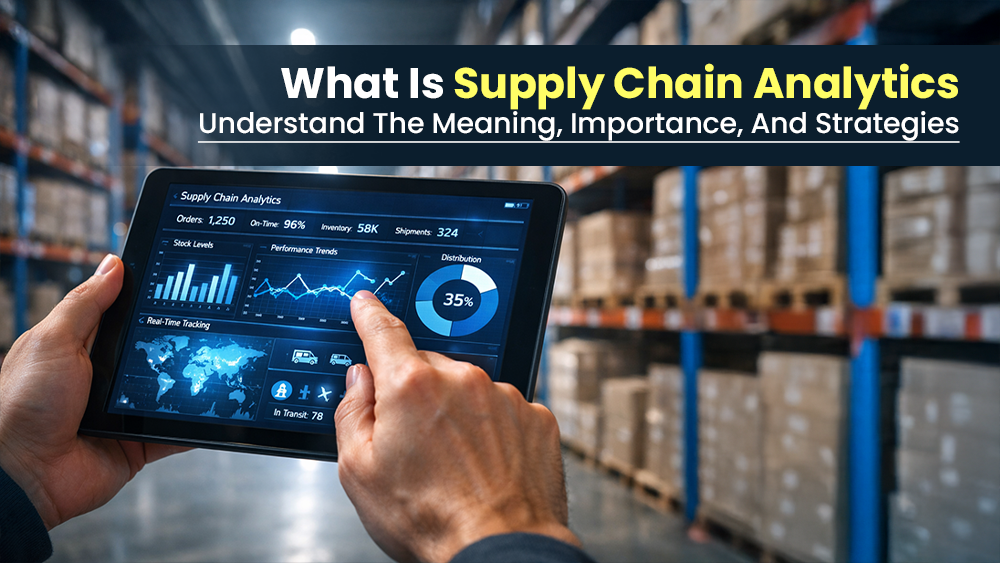
As businesses are becoming competitive and data-driven, organizations and companies find reliable ways to improve efficiency, reduce procurement costs, and build heathier relationship with customers. To achieve all major aspects, the most desirable and powerful approach is to enable supply chain analytics. From predicting demand and planning inventory, to optimizing data, a smart and intelligent supply chain analytics leads to smarter, faster, and more profitable businesses.
Additionally, the evolution of AI-powered tools and platforms to enhance your overall supply chain management, like Cognilix, has been playing a pivotal role in fulfilling every single requirement to boost your sales and growth throughout your business journey. Let's dive deeper to explore the supply chain data analytics, meaning, importance, Types and strategies in detail.
What Is Supply Chain Analytics?
Supply chain analytics is the process of using cutting-edge data cleansing tools, analytics tools, technologies, and techniques to get reliable and actionable insights into supply chain operations. It helps businesses manage, monitor, and analyze activities during the procurement cycle, inventory, transportation, and distribution of products and services. In more comprehensive terms, it provides actionable insights by transforming raw supply chain data to drive the business with better decisions.
Key Components:
- Data collection (from suppliers, warehouses, logistics, etc.)
- Data processing and integration
- Predictive modeling and forecasting
- Visualization and reporting
Understand The Different Types of Supply Chain Analytics
The supply chain is the core element for establishing a successful business. They are further categorized into 4 types, which include:
- Descriptive analytics: This type of supply chain analytics helps in providing historical data to identify and understand the past activities and what has already happened.
- Example: Monthly sales reports, inventory levels, and delivery timelines.
- Diagnostic Analytics: To identify the root cause of any issue during entrie supply chain cycle, diagnostics is the right option.
- Example: Why have delivery delays increased in a particular region?
- Predictive Analytics: This type of analytics utilizes cutting-edge technology models, tools, and machine learning to forecast and predict future outcomes.
- Example: Using inventory planning tools for predicting demand for spikes during festive seasons.
- Prescriptive Analytics: This type of analytics assists in suggesting actionable follow-ups and approaches based on provided data insights.
- Example: Recommending optimal inventory levels or delivery routes.
What is the Importance of Supply Chain Analytics?
Supply chain analytics has become a necessity for every business to improve its overall growth and establish a powerful bond between customers and even suppliers.
- Improved Decision-Making: It empowers businesses to make reliable and data-driven decisions without relying on guesswork.
- Cost Reduction: Supply chain analytics analyzes the inventory, procurement cycle, and transportation, which helps in reducing unnecessary expenses.
- Enhanced Demand Forecasting: One of the key aspects of supply chain analytics is the accurate demand and inventory forecast, allowing businesses to maintain the stock level and avoid last-minute rush or overstocking problems.
- Better Risk Management: Improves the coordination with the supplier by eliminating delays and demand fluctuations.
- Customer Satisfaction: The proper incorporation of SCM through fanatics ensures timely delivery and availability of products, leading to improved customer satisfaction.
Key Benefits of Supply Chain Analytics
Data analytics in the supply chain has multiple benefits, such as:
Real-Time Visibility
Supply chain analytics provides end-to-end visibility during the entire stage of supply chain cycle, which includes procurement, warehousing, and even distribution. Even the dashboards and tracking system make it easier to monitor inventory levels and shipment status accurately.
Better Inventory Management
Optimizing inventory is one of the key advantages of supply chain analytics. It empowers businesses to analyze historical data, previous sales reports, and demand-supply trends or patterns, which helps in maintaining the right balance.
Faster Response to Market Changes
In today's dynamic market, customer preferences change, seasonal buying increases or decreases, and may experience unusual disruption. Therefore, supply chain analytics helps quickly adapt to every trend with reliable and predictive insights and real-time data.
Improved Supplier Performance
Evaluating and monitoring the performance of the supplier is a priority for every business. This can be achieved through proper incorporation of AI-powered procurement tools and strategies of supply chain analytics, which ensures timely delivery, maintains the standards and quality, and makes it more cost-efficient.
Enhanced Logistics Optimization
Logistics plays a major role in cost fluctuation in the entire supply chain management. Therefore, logistic analytics helps in better control over transportation, delivery routes, and freight costs.
Quick Look at the Key Metrics in Supply Chain Analytics
It is pivotal to understand the key performance indicators (KPIs) to measure every aspect of supply chain operations and management.
- Inventory turnover ratio
- Order fulfillment cycle time
- On-time delivery rate
- Demand forecast accuracy
- Supply chain costs
- Perfect order rate
Focus On the Essential Strategies for Effective Supply Chain Analytics
It may sound easier to implement supply chain analytics, but it requires the right technique and approach to successfully structure and gain effective results. Let's have a quick look at them:
1. Centralize Data Sources: Analyze the collection of essential data fetched from the entire supply chain touchpoints and put them into a unified system to get better visibility.
2. Invest in Advanced Technology: Integrating AI-powered and machine learning procurement tools, Inventory optimization, and data cleansing tools to elevate every aspect of supply chain management.
3. Focus on Real-Time Analytics: Opt for tools and strategies that provide real-time insights, data, and dashboards for better and faster decision-making.
4. Collaborate Across Departments: Create a unified collaboration and strong bond between different departments and teams, like procurement, logistics, sales, and finance.
5. Improve Data Quality: Always integrated Ai powered and reliable data cleansing tools for accurate and actionable insights.
Conclusion
The supply chain has been a core aspect of any business that requires proper management throughout the entire business cycle. So, focusing on elevating the quality of data helps in enhancing efficiency, reducing costs, and making businesses competitive in rapidly evolving markets. Therefore, data analytics in the supply chain has transformed the business cycle, which majorly focuses on improving demand forecasting, logistic fluency, and managing risks, leading to taking the right decisions.
However, the availability of AI-powered and machine learning tools has made supply chain easier, but opting for the right data cleansing tools, inventory forecasting tools, and AI-led procurement tools is crucial. As the technology is booming, it has simplified the complete supply change of business and entries, leading to a reliable, sustainable, and profitable business.